2nd Generation Stars
“Let there be light,” and there was light. (Genesis 3)
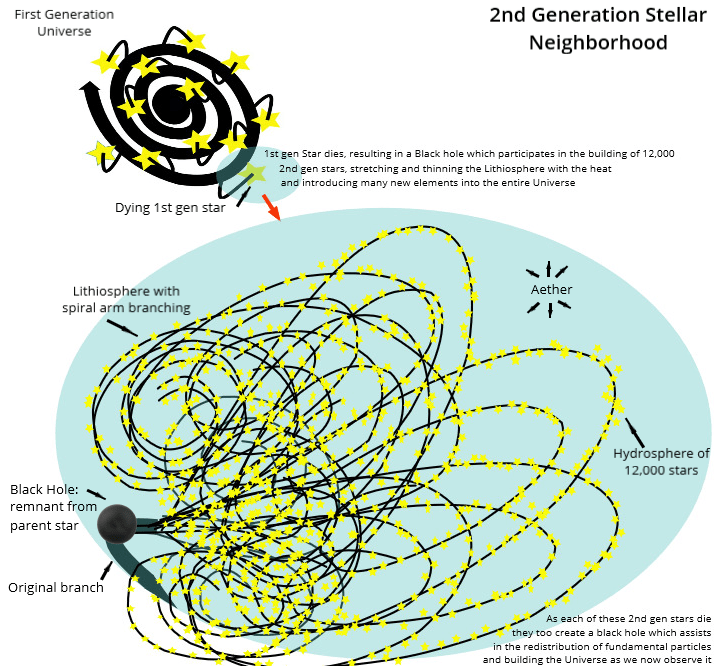
Here we come to the part of the big bang in which we can actually see light appearing in the observable universe some 13.77 billion years ago. As the 1st Generation Stars began dying off, each of the twelve original stars gave birth to one black hole and 12,000 new stars. These next generation stars proved to be much more resilient and were much brighter than the dim stars that came before them, as they had a lot more elements to use as building material for their structures, and they were much larger not to mention much more massive than their parent star. They also had a lot more room in between other star systems in space and were able to create stable and secure stellar neighborhoods of their own. As these young stars spun (not quite as rapidly as their progenitors but still quite rapidly) they stirred their areas of influence close about them and gave the elements a chance to encounter a vast assortment of other elements which brought about the construction of new and much more exotic materials. These structures consisted of gaseous clouds and even small solid objects of the heavier elements now being developed in the system. These objects of metals and rocks were very unstable and rare in formation and quickly dissolved from the still swift swirling of these neighborhoods.
As these next generation stars, all 144,000 of them, spun about the universe, some began venturing far away from the center, so distant that they would lose the influence of the binding black hole of its parent star and drift about their closest neighbors instead, creating a new type of stellar neighborhood that shared resources with each other, setting an example for their children to follow when forming their own galaxies. These are the stars that gave birth to the universe we now see around us, creating stellar nursery’s brimming with stars of varying structure, from the massive, short lived Hot Blue Stars to the more diminutive yet resilient Red Dwarf Stars that survive a lot longer.
The 2nd generation of stars sprouted up about 300 million years after the initial expansion of the universe and lasted until their ultimate collapse less than a billion years later, but they would give birth to all we see around us in the universe including the very first stable planets. As the 2nd generation parent star dies it too would leave a black hole anchoring its previous position, giving the elements swirling about from the debris a stable environment to gain new structure as stars and planets. These newly formed stars, this 3rd generation, would cluster around the black hole, each would become their own solar system that could protect and nurture their own planets and evolve and mature their environment for future growth.
While all this is occurring in the Hydrosphere, the Lithiosphere is undergoing its own transformation. Following the spiral sequence already well established at birth, the Lithiosphere began to grow out from the newly created Node at the end of its Branch, stretching, thinning, and twisting out from its center. During this process, the metal content of the Lithiosphere also began to undergo a transformation as it formed into lighter and lighter materials. Elements such as lead, aluminum, and nickel and even some gases could now be found in abundance throughout the branches. This would allow for the transition of the Lithiosphere’s branching system to transform from its dense, hard metallic structure of the 2nd generation to a more flexible and stable metalloid structure in its next iteration. As black holes in the Hydrosphere created a closing off of the Lithiosphere’s Branch, a pocket would grow at the end of that Branch and slowly fill with particles, creating a Node of varying elements. As these Nodes filled, the elemental particles would then begin to create new threadlike filaments of a Lithium based alloy that then spiral out to the center and give balance and assistance to the Hydrosphere during the birth and restructuring of its soon to be established 3rd generation of Stars.


You must be logged in to post a comment.